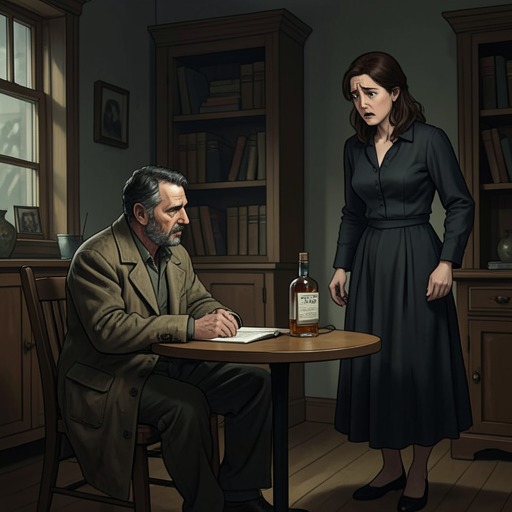
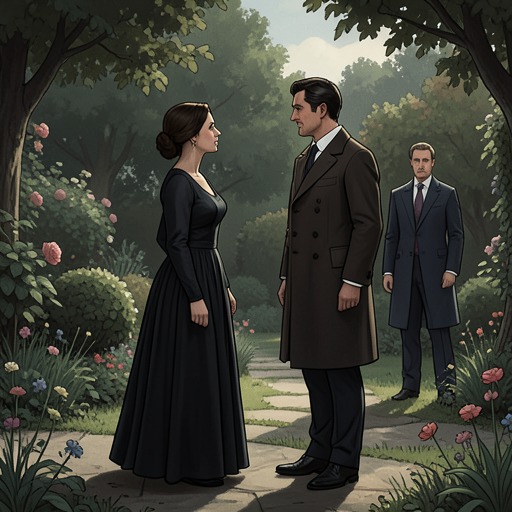
Lord Lowborough refuses to challenge Huntingdon to a duel
The Tenant of Wildfell HallLord Lowborough refuses to challenge Huntingdon to a duel when Hattersley offers to arrange one. The refusal is a decisive test of self-command: Lowborough acknowledges that revenge and self-destruction both tempt him, yet declines to make violence the answer to betrayal. Helen witnesses his choice and the continuing struggle behind it, so the episode presents restraint not as ease or forgiveness, but as a difficult commitment to leave judgment and life in God’s hands.
Background and Immediate Crisis
Lowborough enters this episode in a state of acute distress after learning that Huntingdon has been involved with his wife, Annabella Lowborough. His discovery has left him feeling deceived, and he accuses Helen of having known the truth without telling him. Helen replies that she did not assist in deceiving him. The exchange establishes the personal injury behind the duel offer: Lowborough is not responding to a remote insult, but to a betrayal that has shaken his trust and intensified his despair.
The setting underscores how close the crisis is to Helen’s own life. Lowborough and Annabella occupy rooms next to hers, and his room is close enough that Helen can hear him pacing through much of the night. His distress is therefore present to her not just as an argument, but as a continuing ordeal unfolding beside her chamber.
Hattersley’s Offer and Lowborough’s Refusal
Hattersley offers to help Lowborough make matters right by arranging a meeting with Huntingdon. He identifies the proposed remedy as an exchange of shots, implying that a duel might restore Lowborough’s sense of justice or bring relief if one of the men were killed. Hattersley speaks as a friend offering practical assistance, but his proposal would turn Lowborough’s anger into a potentially fatal confrontation.
Lowborough admits that the same course has occurred to him. He says his own heart, or the devil within him, has suggested meeting Huntingdon and not parting without blood; he recognizes that either man, or both, might fall. The admission makes the refusal meaningful: he is not untouched by the appeal of revenge, and does not pretend that hatred has disappeared.
He nevertheless stops Hattersley’s plan. Though he says that he hates Huntingdon and would rejoice at any calamity that befell him, he will leave Huntingdon to God; though he abhors his own life, he will leave that, too, to the one who gave it. His decision rejects both violence against another person and the destruction of his own life. It is an act of religious restraint made in the presence of impulses he openly recognizes, rather than a claim that he feels no anger or despair.
Helen’s Response and the Night After
When Hattersley condemns Lowborough’s decision and departs, Helen immediately goes to Lowborough and clasps his hand. She praises his choice, telling him that she is beginning to think the world is not worthy of him. Her response marks a change in her attention: she has been preoccupied with her own afflictions, but now recognizes the extent of his suffering and the strength required to resist it.
That night, Helen lies awake listening to Lowborough’s heavy steps moving repeatedly through his dressing room. The next morning, after he and Annabella have gone, a clasp-knife is found on the grass below the window, and a razor is found broken and thrust into the grate. The objects give concrete evidence of how powerful the temptation to end his life has been, while their discarded and broken state records his determination to resist it. His refusal of the duel is thus part of a broader struggle: he does not merely spare Huntingdon; he also chooses not to surrender his own life to despair.
Significance
The episode sets Hattersley’s proposed code of retaliation against Lowborough’s decision to entrust vengeance and life to God. Lowborough neither excuses Huntingdon nor claims to forgive him; his hatred remains explicit. What changes is the action he permits that hatred to dictate. By refusing the duel despite admitting its appeal, he treats self-restraint as an active moral choice under pressure.
Helen’s witnessing of the aftermath expands the moment beyond the confrontation itself. Her attention shifts from her own troubles to the suffering of a man whose trust and affection have been betrayed, and the knife and broken razor make visible the private cost of his restraint. The scene therefore connects resistance to revenge with resistance to self-destruction, presenting both as choices Lowborough must renew amid continuing despair.